

Valuing Employees: The Journeys Past and Future
 Why 30 years of recognition haven’t moved the needle—and what will finally change employee engagement.
 Progress Has Been Real—But Far Too Limited
Why So Little Progress? Four Core Barriers
What Must Change: From Activity to System
What Will Finally Drive Change
A Measured Optimism
Click here to subscribe to RRN weekly, and here for an RRN media kit.
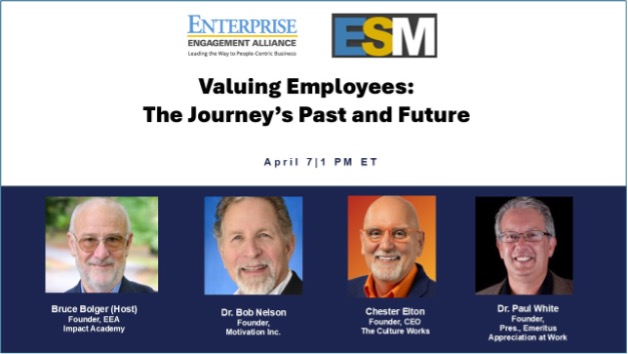
Three of the field’s most influential voices in recognition and appreciation agree: despite decades of advocacy, business has made only limited progress in treating employees as true assets. The reasons range from lack of education and impact measurement to cultural inertia and market pressures. Yet all three see a path forward—one grounded in systems, metrics, leadership accountability, and a shift from “recognition as activity” to “engagement as value creation.”
Guests are Dr. Bob Nelson, President, Motivation Inc.; Chester Elton, Founder, the Culture Works, and Dr. Paul White,Founder, President Emeritus, Appreciation at Work.
Click here to watch and/or listen to the full show.
After more than three decades of books, speeches, and corporate initiatives focused on recognition and appreciation, the state of employee engagement remains stubbornly low. In this conversation, three pioneers in the field reflect on a paradox: widespread awareness of engagement and recognition concepts—but minimal systemic adoption in practice.
Their shared conclusion is striking. While individual leaders and organizations have demonstrated the power of recognition and appreciation, business overall has not embedded these practices into the core operating system of management. The result: engagement remains episodic, misunderstood, and often disconnected from measurable business outcomes.
The conversation makes clear that the issue is not a lack of ideas, tools, or evidence. It is a failure to integrate engagement into the core logic of how organizations operate and measure success. Until engagement is treated not as a “soft” initiative but as a disciplined, measurable system tied to value creation, progress will remain limited. But as economic realities, workforce expectations, and competitive pressures converge, the case for change is becoming harder to ignore.
Progress Has Been Real—But Far Too Limited
All three experts agree that awareness of employee recognition has improved, but meaningful adoption has not kept pace.
Nelson, creator of Employee Appreciation Day, and often credited as a pioneer in the field of recognition in human resources, notes that early in his career he assumed organizations would quickly embrace recognition once its benefits were understood. Instead, he encountered persistent resistance rooted in long-standing management beliefs. As he explained, many leaders still see employees primarily as costs to control rather than assets to develop.
Elton echoes that sentiment, describing recognition as “not a hard concept to understand—but still a hard sell.” Despite the intuitive appeal—“nobody feels over-appreciated,” he notes—relatively few organizations apply it consistently or effectively.
White adds that while pockets of success exist across industries, large-scale organizational transformation remains rare. In many cases, companies attempt sweeping cultural change initiatives that prove difficult to sustain, rather than building engagement practices incrementally through teams.
The consensus: progress has been uneven, localized, and far from systemic.
Why So Little Progress? Four Core Barriers
The discussion highlights several deeply rooted reasons for the lack of advancement.
1. Lack of know-how and training. One of Nelson’s earliest research findings still holds: managers often don’t use recognition simply because they don’t know how. Many also underestimate its importance or feel they lack time. As Elton added, poorly executed recognition can backfire, reinforcing skepticism.
2. Absence of measurement and business linkage. Perhaps the most critical issue is the failure to connect engagement efforts to tangible business outcomes. As the speakers emphasized, many organizations gather data on recognition activity but fail to link it to customer outcomes, retention, productivity, or financial performance. Without that connection, senior leaders have little reason to prioritize it.
3. Structural and market pressures. Public company dynamics create a powerful counterforce. Quarterly earnings expectations often drive decisions that prioritize short-term cost reduction over long-term human capital investment. Elton noted that even well-intentioned CEOs may struggle to act differently under intense market scrutiny.
4. Cultural inertia and rear. Managers often hesitate to engage more personally with employees due to fear—of doing it wrong, appearing insincere, or even facing legal consequences. As Elton put it, in a highly litigious environment, “it feels safer to keep your head down and just hit your numbers.” White added another dimension: business education itself rarely prepares leaders to manage engagement. Few MBA programs meaningfully address culture, recognition, or appreciation as core management disciplines.
What Must Change: From Activity to System
Despite the challenges, the speakers converge on a clear path forward.
Engagement must become a system—not a program. Recognition alone is not enough. It must be embedded within a broader framework that includes appreciation, development, communication, and alignment with organizational goals.
Nelson emphasizes the importance of linking recognition directly to strategic objectives. Rather than generic praise or values-based acknowledgment alone, organizations should recognize behaviors that drive specific business outcomes. “What gets recognized gets done,” he notes. White stresses that change often begins at the team level. By piloting engagement practices within smaller groups and demonstrating results, organizations can build momentum organically. Elton highlights the importance of intentional design—what he calls “gratitude by design”—where recognition is structured, measured, and reinforced through leadership accountability.
What Will Finally Drive Change
The group agrees that the tipping point will likely come from a combination of economic pressure, workforce expectations, and proof of impact.
1. Financial evidence will win the argument. Nelson points out that organizations already spend 60%–90% of their expenses on people. Improving the return on that investment—particularly through reduced turnover—offers a compelling business case. “People stay where they feel valued,” he said, noting the clear financial benefits of retention.
2. Workforce expectations are shifting. Elton highlights growing skepticism among younger workers, particularly Gen Z, who often feel undervalued and disconnected. This generational shift is forcing organizations to rethink how they treat employees—not as expendable resources, but as stakeholders.
3. Competitive advantage will force adoption. Examples from companies like Costco and Texas Roadhouse—cited in the discussion—demonstrate that organizations investing in people can outperform peers in both retention and profitability. As more data emerges, lagging organizations may be compelled to follow.
4. Leadership and culture must align. Ultimately, change requires CEO-level commitment. Engagement cannot be delegated to HR alone; it must be integrated into how organizations define success and measure performance.
A Measured Optimism
Despite decades of slow progress, all three experts remain optimistic. White emphasizes that engagement practices are not inherently complex. “It’s not intellectually difficult,” he says. “It just takes discipline.” When implemented correctly—even at small scales—the results are often immediate and compelling.
Elton points to the ripple effect of effective leaders. When managers genuinely care, understand their people, and act accordingly, engagement spreads organically. Nelson underscores a simple but powerful truth: recognition works. The challenge is not proving its value, but ensuring it is applied consistently and strategically.
Click here to take a free anonymous test to benchmark your own abilities to foster the proactive involvement of your organization, teams, customers, or distribution partners.
Enterprise Engagement Alliance Services
Celebrating our 15th year, the Enterprise Engagement Alliance helps organizations enhance performance through:
1. Information and marketing opportunities on stakeholder management and total rewards:
ESM Weekly on stakeholder management since 2009; click here for a media kit.
RRN Weekly on total rewards since 1996; click here for a EEA YouTube channel on enterprise engagement, human capital, and total rewards insights and how-to information since 2020.
2. Learning: Purpose Leadership and Stakeholder
 Management Academy to enhance future equity value and performance for your organization.
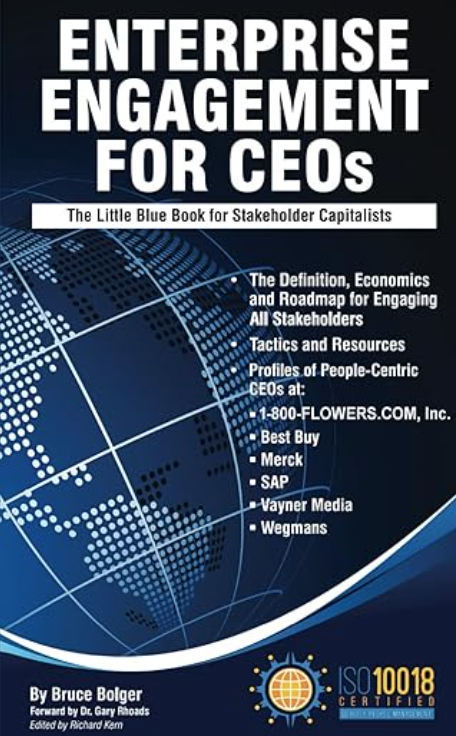
3. Books on implementation: Enterprise Engagement for CEOs and Enterprise Engagement: The Roadmap.
4. Advisory services and research: Strategic guidance, learning and certification on stakeholder management, measurement, metrics, and corporate sustainability reporting.
5. Permission-based targeted business development to identify and build relationships with the people most likely to buy.
6. Public speaking and meeting facilitation on stakeholder management. The world’s leading speakers on all aspects of stakeholder management across the enterprise.